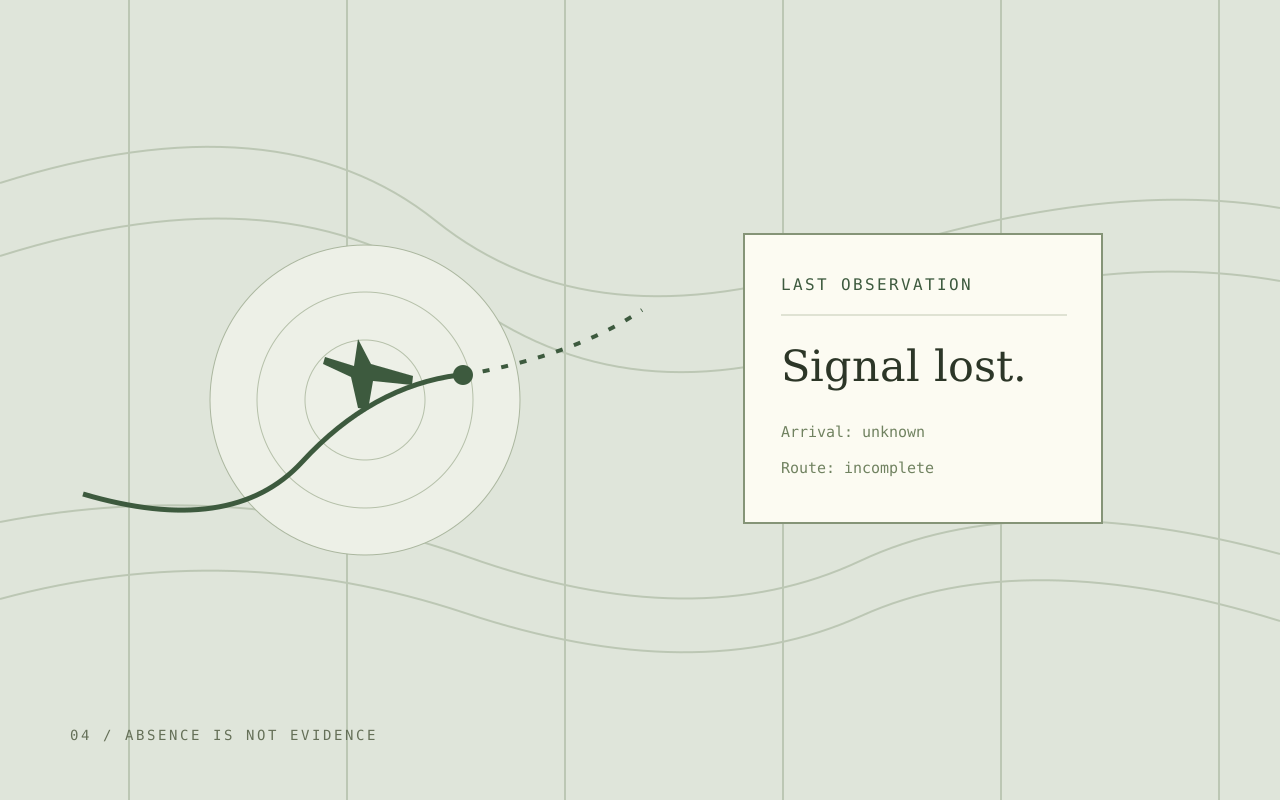
A line on a map stops. The tempting story is that the aircraft arrived, the owner met someone nearby, or a privacy program hid the rest. The data alone may support none of those conclusions.
The first question is simpler: what did this feed actually observe, and when? Once you separate an observation from an inference, most flight-tracking gaps become easier to describe honestly.
There is more than one reason for a gap
Public flight trackers depend on collection, transmission, processing and display. A failure or restriction at any of those stages can remove an aircraft from view. A web page that refreshes now may still be showing a position recorded much earlier.
Scroll to see all columns
| Cause | What it can look like | What the gap does not prove |
|---|---|---|
| Display filtering | An aircraft missing from a participating service | That every data source has the same restriction |
| Receiver coverage | A trace stops over poorly covered terrain or water | That the aircraft landed there |
| Provider or processing delay | New positions appear late | That the aircraft is currently at the old position |
| Identification mismatch | A registration search returns no result | That no flight took place |
Different providers can share upstream collection networks. Agreement between two trackers is not always independent confirmation; they may be missing the same observations for the same reason.
What LADD means
The FAA’s Limiting Aircraft Data Displayed program gives owners or designated representatives a process for requesting limitations on aircraft data. Participating vendors receiving FAA data are bound by their data-access agreement to honor the program’s requirements.
The FAA describes distinct options. FAA-source filtering limits distribution of the relevant FAA data to external vendors. Subscriber-level filtering allows vendors to receive it but restricts public display, with authorized access arrangements possible for owners or operators.
This is a distribution and display policy. It should not be treated as a universal explanation for every missing aircraft or every interrupted line. The right research response is to describe the source’s visibility limits, not claim to have discovered a hidden itinerary.
Why ADS-B coverage is uneven
The FAA’s ADS-B FAQ explains that radio-station range depends on altitude and terrain, with practical limits from transmitter power and receiver sensitivity. A public receiver network also depends on where its contributors have equipment.
An observation may therefore disappear during cruise and reappear later. Switching websites does not necessarily fill the gap. The record available to you can be incomplete even when the flight itself proceeded normally.
For a visual explanation of the collection layer, Flightradar24 links the following video from its own receiver-coverage case study. It explains ADS-B reception, a different subject from LADD display policy or proof that a particular aircraft landed.
What a trace can establish
- ObservedA position at a stated time, from a stated source.
- MissingNo reliable observation for part of the route.
- UnresolvedAn arrival or current location that still needs evidence.
Separate last seen from live
Always retain the observation timestamp. “Last seen 40 minutes ago” communicates something quite different from “live position,” even if the interface has just loaded. An old location should not acquire a fresh timestamp simply because a server fetched the same record again.
Consider an invented example: you open a tracker at 14:40 UTC, but its latest airborne observation is stamped 14:00 UTC. Write “last observed airborne at 14:00 UTC; current status unresolved.” The page’s 14:40 refresh time cannot establish where the aircraft is now. A later observation may resolve the gap; refreshing the same stale point cannot.
The same caution applies to headings. A heading at cruising altitude is not a destination prediction. Aircraft reroute, follow airways and alter course around weather and restricted airspace. Projecting the last heading toward a nearby airport can generate a very precise answer with very little evidence.
When a trace stops while the aircraft is still at cruise, the defensible description is “last observed in flight.” Confirm an arrival with suitable later evidence rather than snapping the track to the nearest airport.
Do not turn movement into a meeting claim
Aircraft ownership and aircraft operation are not identical. Registrations can change, ownership may run through entities, and flights can involve maintenance, positioning or charter activity. Even a correctly identified aircraft does not tell you who occupied a seat.
Nor does a flight to a business center establish a deal. Treat movement as a lead that may justify checking public announcements and filings. Keep any unverified interpretation clearly separate from the observed event.
This is the same discipline used when reading 13F snapshots or congressional trade reports: a data point answers a limited question, and the missing context still matters.
How Mountainhead treats the limitation
Mountainhead is our product. Its research surface can put public movement events alongside other evidence. Its public API exposes sanitized events, subject to delay and suppression rules; it does not expose raw position tracks or unresolved destination predictions.
Coverage remains imperfect. An absent event is not proof that a flight did not occur, and an observed flight is not proof of a passenger or meeting. The data policy and MCP guide describe the public surface. Use them to understand what a tool can return before building an automated interpretation on top of it.
Questions worth asking
What does the FAA LADD program do?
LADD lets eligible owners or operators request limits on aircraft data distributed through the FAA's feed or publicly displayed by participating vendors. FAA-source filtering and subscriber-level display filtering are different options.
Does a missing flight trace mean the aircraft landed?
No. A feed can lose coverage while an aircraft is still airborne. The last recorded position describes where it was observed at that time, not its destination, its current location or a confirmed landing.
Can flight data prove a named person was on board?
An aircraft observation does not identify its passengers or establish why a flight occurred. Aircraft can have changing owners, operators, charter arrangements and maintenance flights. Passenger or meeting claims require independent evidence.
Go to the source
This guide is research and education, not investment advice. Public records can arrive late, contain errors, or be amended. They do not establish intent or predict returns. Check the original filing and its date before relying on it.