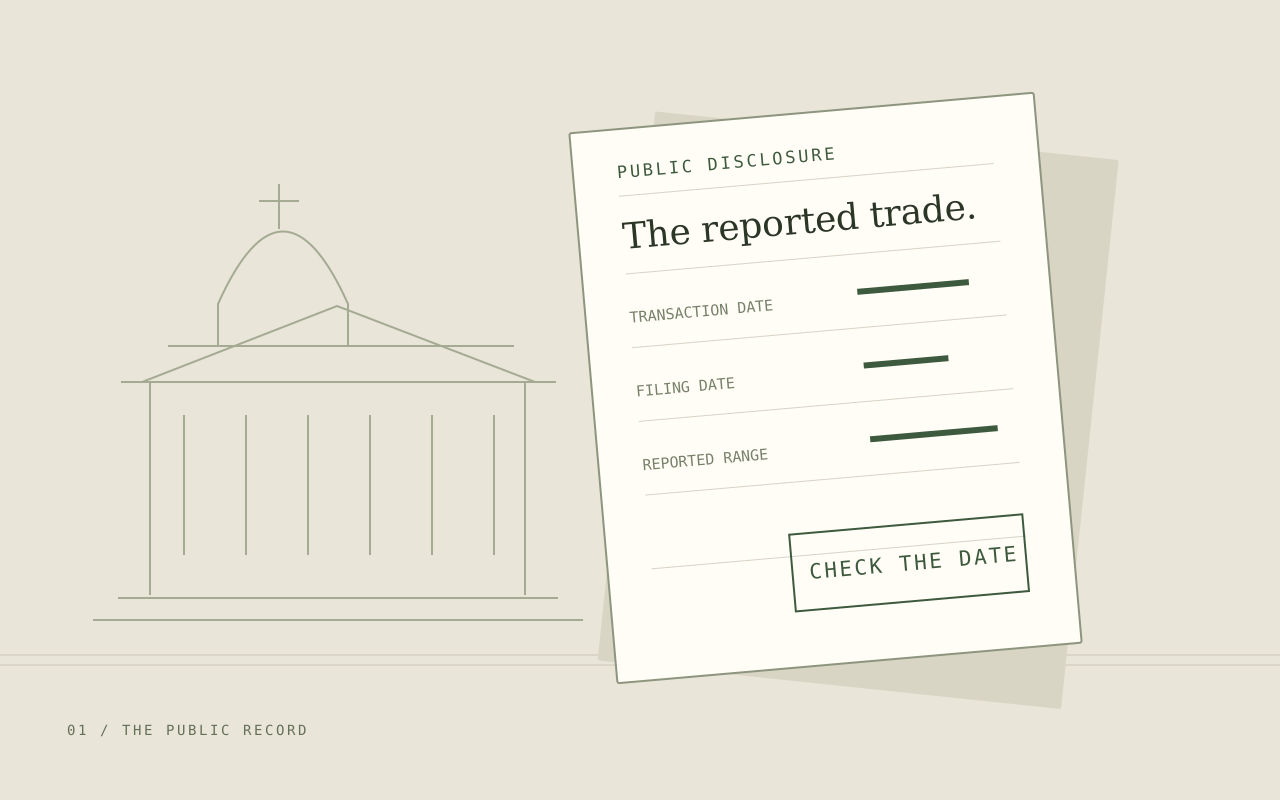
The headline says a member of Congress bought a stock. Before opening a chart, ask a more useful question: when did the trade happen, and when did the public learn about it? Those dates are often different. A feed that collapses them into one timestamp makes an old decision look new.
This guide is a practical way to find the record, read it carefully, and decide what deserves further research. It is not a strategy for copying a politician’s portfolio.
Start with the right disclosure system
House members file through the Office of the Clerk. Senators use the Senate’s electronic financial-disclosure system. Search by name and reporting year, then distinguish a periodic transaction report, often called a PTR, from an annual financial disclosure.
An annual report describes a wider set of interests over its reporting period. A PTR reports covered transactions. They answer different questions and should not be treated as interchangeable downloads. Read the site’s access notice and permitted-use requirements before obtaining or reusing records.
Save the document URL, the reporting person’s name and the report type alongside any extracted row. If you later discover a parsing error or amendment, that source link is the shortest path to correcting your research.
Understand the reporting clock
The House Ethics Committee states that covered securities transactions over $1,000 must be disclosed by the earlier of 30 days after the filer is made aware of the transaction or 45 days after the transaction. Calling this a fixed 45-day delay is misleading: it is an outer deadline under the general rule, not a publication schedule.
Track at least three dates: the transaction date printed on the report, the report’s filing date, and the time your own system obtained it. A newly ingested row can refer to a much older trade. Late filings, corrections and provider backfills make that distinction especially important.
Three clocks, one disclosure
- TransactionThe date of the reported purchase, sale or exchange.
- DisclosureThe date the report was filed or made public.
- ObservationThe time a research tool first retrieved the record.
Here is a hypothetical example. A transaction dated June 3 appears on a report filed July 8 and enters a research feed July 9. Label it “reported July 8; traded June 3.” Describing it as a July 9 purchase would erase the information gap that matters most to a reader.
A useful note keeps the uncertainty attached to the row:
Hypothetical research note: A spouse-owned purchase of Example Company was reported in the $15,001 to $50,000 range. Transaction: June 3. Filing: July 8. Retrieved: July 9. Source: the original PTR. Execution price, exact share count and current ownership are not supplied by this row.
The filing date alone also does not tell you when the filer received notice. Assessing whether a report was timely requires applying the actual deadline rules, rather than assuming every report inside 45 days was on time.
Read the owner and the amount
The member’s name on a report does not automatically mean the member personally placed every order. Check the ownership notation and accompanying explanations. A spouse’s or dependent child’s transaction should retain that attribution.
Amount ranges also matter. If a report lists $15,001 to $50,000, retain that interval. The midpoint is an estimate chosen by an analyst, not a disclosed fact. You cannot safely divide that midpoint by a closing price and call the result the official share count.
Scroll to see all columns
| Field | What to record | What not to infer |
|---|---|---|
| Owner | The reported ownership category | Who personally made the decision |
| Transaction | Purchase, sale or exchange as filed | A complete current position |
| Amount | The full disclosed range | An exact execution value |
| Asset | Name, description and available identifier | A ticker without checking the instrument |
| Dates | Transaction and filing dates separately | That “new to the feed” means “just traded” |
Options, funds, bonds and individual shares are different instruments. A familiar company name is not enough to decide which one a row describes. Preserve the description and any explanatory notes when normalizing the data.
Build a repeatable research routine
- Find the source report. Confirm the member, chamber, document type and reporting year.
- Read the entire row. Capture the asset, owner, transaction category, amount range and relevant dates.
- Look for amendments. Preserve the relationship between a corrected report and the original, rather than counting both as independent purchases.
- Check the business context. Read the company’s filings and contemporaneous announcements. A disclosure alone does not explain the motivation.
- Write down the uncertainty. Identify what is reported, what you inferred, and what remains unknown.
If you compare activity across people, normalize dates and instruments first. Five reports filed on the same day need not describe a coordinated set of trades. The transactions may have occurred weeks apart.
Keep different records in different columns
Congressional PTRs are not SEC Form 4 insider reports, which describe changes in ownership by covered corporate insiders. Nor are they OGE Form 278-T reports, which belong to the executive-branch disclosure system.
Putting these records together can help frame a research question. It does not make their timing, thresholds or coverage identical. Label the source type and avoid treating every disclosure as one generic “insider buy.”
Where Mountainhead fits
Mountainhead is our research product. Its terminal and disclosure tools help organize congressional activity alongside company filings and other public records. That can shorten the path from an interesting report to its surrounding evidence. Developers can use the same idea in a source-linked agent workflow.
The limit is important: aggregation does not remove reporting delays or guarantee complete coverage. An extracted row is a convenience; the official report is the record. We do not infer a politician’s current portfolio, trading intent or future return from a PTR.
The useful outcome is a better research note: who reported what, when it happened, where the evidence lives, and which question to investigate next.
Questions worth asking
Where can I see congressional stock trades for free?
The House Clerk and Senate financial-disclosure systems provide access to their respective public reports. Use the member's name, the relevant reporting year and the periodic transaction report type. Follow each system's access and use requirements.
How long do members of Congress have to report a stock trade?
For covered transactions, the general deadline is the earlier of 30 days after receiving notice of the transaction or 45 days after the transaction. A report may be filed sooner, and late or amended reports also occur.
Does a congressional trade report show the exact amount invested?
Reports generally disclose transaction amounts in ranges. A reported range is neither an exact dollar amount nor a reliable way to calculate the number of shares. The ownership field may also identify a spouse, dependent child or joint holding.
Go to the source
This guide is research and education, not investment advice. Public records can arrive late, contain errors, or be amended. They do not establish intent or predict returns. Check the original filing and its date before relying on it.