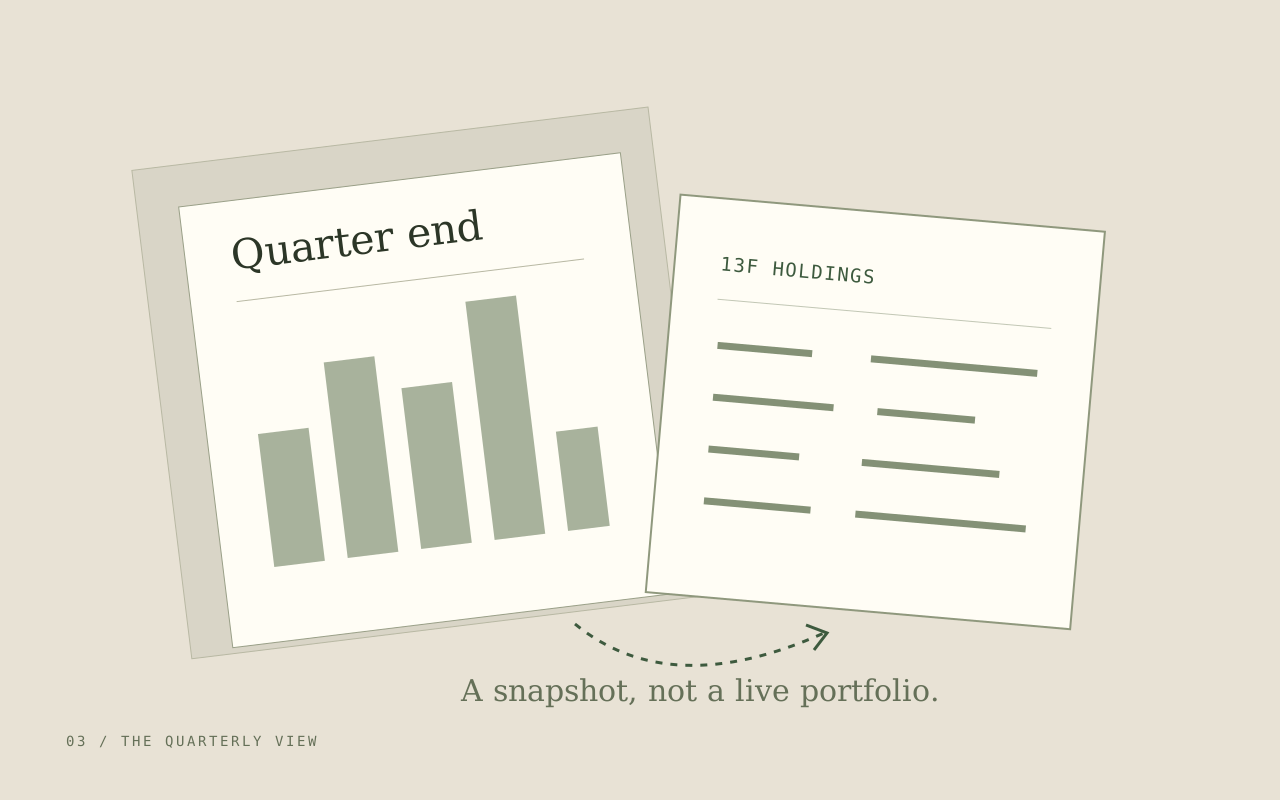
A fund’s latest filing arrives, and a headline announces its “new portfolio.” The document usually describes something narrower: reportable holdings at the end of an earlier quarter. By the time it becomes public, the manager may already have traded again.
That does not make Form 13F useless. It makes the timestamp and the scope essential parts of the analysis.
What a 13F actually reports
As the SEC explains on Investor.gov, institutional investment managers meeting the $100 million threshold in Section 13(f) securities generally report those holdings quarterly. The universe includes certain exchange-traded equity securities, options, warrants and other listed instruments. It is not shorthand for all assets under management.
The filers are broader than hedge funds. Investment advisers, banks, insurers, pension funds and corporations may also meet the requirements. Check the legal reporting entity rather than assuming the filing belongs to a single celebrity manager’s personal investment book.
Find a manager in EDGAR, open the 13F report, and identify the reporting period, report type, information table and any amendments. Keep the accession or source link with your extracted data.
Keep quarter end separate from publication
The general filing deadline is 45 days after the end of a calendar quarter. The period describes when the snapshot was taken. The filing date describes when it reached the SEC. Your data provider may observe it later still.
Imagine a hypothetical filing for June 30 submitted in August. It tells you about reportable holdings on June 30. It does not prove the manager bought in August, still owns the securities today, or paid the quarter-end quoted price.
The snapshot and the gap
- Quarter endThe reportable holdings are measured at the period end.
- Filing windowThe manager submits the report under the applicable deadline.
- Your researchYou analyze a historical snapshot, with subsequent trades unknown.
Compare shares, not just market value
An information table identifies securities and reports quantities and market values. A larger value in the next quarter may reflect a higher share price rather than additional buying. Start with comparable share counts, then account for splits, security-class changes and other corporate actions.
Scroll to see all columns
| Observation | Possible interpretation | What to check first |
|---|---|---|
| Higher market value, same shares | Price movement | Identical security and quantity units |
| More reported shares | A larger quarter-end reported holding | Splits, amendments and manager/entity changes |
| A newly appearing line | New public visibility for that period | Prior confidentiality or reporting changes |
| A disappearing line | No reportable holding in that table | Amendments, identifiers and reporting scope |
A worked quarterly comparison
Suppose a manager reports 20,000 shares worth $2 million at one quarter end and 22,000 shares worth $2.64 million at the next. In this hypothetical example, shares increased 10% while reported value increased 32%. The rest of the value increase reflects a higher implied quarter-end price, from $100 to $120.
The defensible summary is “10% more reported shares between these quarter ends,” assuming the same instrument, units and reporting entity and no split or amendment. The two snapshots still do not tell you the execution dates or prices of any trades between them.
Use the value units specified by the relevant form or source dataset. Do not blindly apply a “multiply by 1,000” rule copied from a historical parser. A unit error can turn a reasonable position into an imaginary multibillion-dollar holding.
A comparison is most useful when you preserve the manager identifier, security identifier, security class, put/call flag where applicable, reporting period, share units and source filing. Matching on ticker alone can blur different instruments.
Understand the missing pieces
A 13F is not a balance sheet of the manager’s entire risk. It does not provide a full inventory of cash, shorts, private investments and every other asset or liability. A visible long holding may sit alongside exposures you cannot see in the report.
The form also does not disclose a complete purchase history or cost basis. The manager could trade in and out within a quarter without leaving the sequence visible in two quarter-end snapshots. Confidential treatment can delay public visibility for certain holdings, and amendments can correct or supplement a report.
These limits are reasons to narrow your question. “Which reportable holdings changed between these two periods?” is answerable. “What is the manager buying right now?” generally is not.
Build a comparison you can defend
- Find the same reporting entity for both periods.
- Confirm each report’s quarter-end date and whether an amendment changes the comparison.
- Reconcile securities using identifiers and instrument details, not names alone.
- Compare quantities, then separately compare market values.
- Label additions and exits as changes in reported holdings, retaining the snapshot dates.
- Open the company’s own filings to develop an independent explanation of the business.
If you also inspect Form 4 insider activity, preserve its transaction-level dates. If you add congressional disclosures, preserve their amount ranges. Different disclosure systems add context only when their differences remain visible.
Where Mountainhead helps, and where it stops
Mountainhead is our product. Its institutional-holdings tools help surface changes and place them alongside company information. That is a starting point for locating interesting records, especially when a researcher wants to move between several sources.
The product cannot reconstruct a fund’s live portfolio from quarterly filings. Coverage and identifiers can be imperfect, and a manager’s public positions are not a substitute for your own valuation work. An agent connected through MCP should state the reporting period in its answer and link the underlying filing rather than describing the snapshot as current.
Questions worth asking
When are 13F filings due?
Form 13F is generally due within 45 days after the end of a calendar quarter. The holdings describe the quarter-end reporting date, not the later date on which an investor reads the filing. Check the applicable SEC deadline calendar for a specific filing.
Does a 13F show every investment a hedge fund owns?
No. It covers reportable Section 13(f) securities, not every asset or liability in a portfolio. The form does not provide a complete view of shorts, cash, private investments or other exposures, and confidential treatment may delay some public information.
Can I tell when a fund bought a stock from its 13F?
A 13F does not give a trade-by-trade purchase history. Comparing share counts across periods can identify a reported change, but does not supply the execution dates, cost basis or trading activity between the snapshots.
Go to the source
This guide is research and education, not investment advice. Public records can arrive late, contain errors, or be amended. They do not establish intent or predict returns. Check the original filing and its date before relying on it.