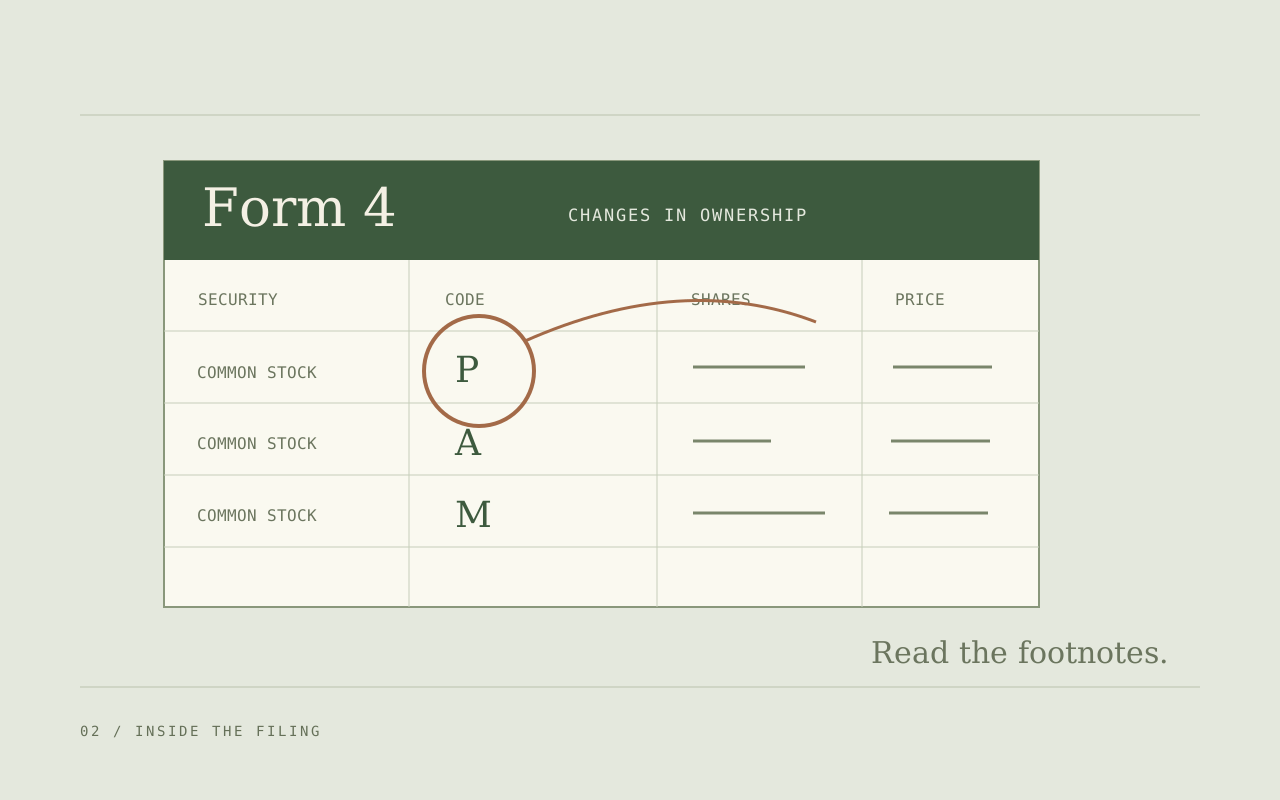
“The CEO acquired shares” sounds simple until you open the filing. The shares might have been purchased, awarded as compensation, or acquired through an option exercise. Those events all change ownership, but they do not tell the same story.
Form 4 is useful precisely because the original record lets you make those distinctions. Read it as a structured document before turning it into a bullish or bearish label.
Know what the form covers
Covered officers, directors and beneficial owners of more than 10% of a registered class of equity securities use the SEC’s ownership-reporting forms. Form 3 establishes an initial ownership report. Form 4 generally reports changes. Form 5 addresses certain annual reporting obligations.
Most transactions reported on Form 4 are due within two business days. That makes it more timely than many other disclosure datasets, but it still is not an execution feed. Preserve both transaction and filing dates, including when an amendment arrives.
The word “insider” in this context describes a reporting relationship. It is not an allegation. Illegal insider trading involves a separate set of facts concerning material nonpublic information and duties of trust or confidence.
Decode the transaction before the headline
Read the transaction code together with the security title and the acquisition or disposition indicator. Do not equate the letter A in an acquisition/disposition column with the separate transaction code A.
Scroll to see all columns
| Transaction code | General meaning | Research caution |
|---|---|---|
| P | Open-market or private purchase | The code does not identify the purchase venue by itself |
| S | Open-market or private sale | A sale does not explain the seller’s motivation |
| A | Grant, award or other acquisition under the relevant exemption | Not the same as spending cash on an open-market purchase |
| M | Exercise or conversion of a derivative security under the relevant exemption | Read the option terms and related entries |
| F | Payment of exercise price or tax liability through delivery or withholding of securities | Do not automatically label it a discretionary sale |
This is a reading aid, not the full code list. The Form 4 instructions define the codes and exceptions. A single filing can contain multiple rows whose economic meaning only becomes clear when read together.
Read both tables and every referenced footnote
Table I covers non-derivative securities; Table II covers derivative securities. An option exercise can create a row in one table and a related change in the other. Counting each row as an independent purchase would inflate the activity.
For each material row, capture the number of securities, reported price or price explanation, securities owned after the transaction, and direct or indirect ownership designation. Footnotes can explain a price range, a trust, shared beneficial ownership, a gift or a prearranged plan.
A useful reading order
- ClassifyIdentify the security, transaction code and acquisition or disposition.
- ReconcileConnect related rows across the tables and read the ownership notes.
- ContextualizeCompare the event with prior holdings and company disclosures.
A price of zero does not mean the filer found free shares on an exchange. It may describe an award, a transfer or another transaction where the field has a different meaning. Likewise, an indirect holding is not automatically the reporting person’s freely tradable personal account.
Put the size in context
Consider a hypothetical officer who buys 2,000 shares at $25 and reports 102,000 shares afterward. The gross transaction value is $50,000, but that arithmetic alone does not tell you whether the purchase represents a meaningful change in the officer’s overall exposure.
If the officer held 100,000 shares immediately before the purchase, the reported share count grew by 2%. That is a more useful description than the dollar amount alone. This example assumes the same security and ownership category and no other changes; it does not measure the officer’s total wealth or conviction.
A checkable summary: “The officer reported a P-coded purchase of 2,000 common shares at $25, with 102,000 held afterward in the stated ownership category.” Add the transaction date, filing date and source link before interpreting it.
Compare like with like: the same security class, the same ownership category, and the same reporting person’s prior holdings. Look for stock splits, related derivative positions, amended filings and footnotes before calculating percentage changes.
Several independent purchasers at one company can be worth a closer look. It is still a pattern to investigate, not evidence that they share an undisclosed plan or that the stock will rise. Check whether the entries actually represent discretionary purchases rather than a common compensation event.
Avoid three common shortcuts
Treating every acquisition as a buy. Compensation awards and exercises deserve their own labels. Keep transaction codes visible when building a screen.
Treating every sale as a forecast. A filing can disclose activity associated with a prearranged trading plan. It does not reveal all the person’s reasons for selling. Read the form’s plan information and notes rather than inventing a motive.
Treating a timely filing as fresh valuation work. Even a two-business-day report may arrive after a substantial price move. Public information about the underlying company remains more important than the appeal of copying an executive.
For comparison, 13F holdings are quarterly snapshots, while congressional trade reports have different reporting rules. Do not combine all three into a single unqualified “smart money” metric.
Use Mountainhead as an index to the evidence
Mountainhead is our product. Its insider-trade and cluster tools help organize Form 4 activity alongside company filings and market context. A useful workflow is to locate a reported purchase, open the source, then inspect the surrounding disclosures.
Its limits are the limits of aggregation: source delays, parsing mistakes, amendments and incomplete coverage remain possible. A ranked signal is not a recommendation. Keep a citation in the research note and follow the agent workflow only if it preserves that traceability.
Questions worth asking
How quickly must an insider file a Form 4?
Most covered transactions must be reported within two business days. There are exceptions, and filings may also be late or amended. Keep the transaction date separate from the SEC filing date in any research dataset.
Does transaction code P always mean an open-market purchase?
No. P covers an open-market or private purchase of a non-derivative or derivative security. Read the security description and footnotes before describing the venue, motivation or exact nature of the purchase.
Does an insider sale mean the company is in trouble?
A sale by itself does not establish that conclusion. Liquidity needs, diversification, taxes and prearranged trading plans are possible explanations. A Form 4 reports the transaction; it does not prove the insider's investment thesis.
Go to the source
This guide is research and education, not investment advice. Public records can arrive late, contain errors, or be amended. They do not establish intent or predict returns. Check the original filing and its date before relying on it.